


As the United Nations Support Office in Haiti (UNSOH) provides logistical and operational support to security efforts in Haiti, human rights safeguards are an integral part of how that support is planned and delivered.
Under its mandate, UNSOH primarily supports the Gang Suppression Force (GSF), as well as the Haitian National Police (HNP) and the Haitian Armed Forces (FAd'H) when conducting joint operations with the GSF. This assistance is subject to the United Nations Human Rights Due Diligence Policy (HRDDP), which governs UN support to non-UN security forces. It requires the assessment of human rights risks, the adoption of measures to mitigate those risks, and ongoing monitoring.
UNSOH carries out this work through existing channels for human rights engagement with the Haitian authorities and in collaboration with other United Nations entities.
From policy to practice in Haiti
In Haiti, UNSOH has put in place a framework to apply these requirements through risk assessments, mitigation measures, standard operating procedures, monitoring, and coordination with the entities concerned. Human rights considerations are integrated throughout, from planning and decision-making to delivery and follow-up.
UNSOH also provides policy guidance and technical advice, including in-mission training, review of relevant regulatory frameworks, and outreach to civil society. As part of this effort, UNSOH contributes to induction training for GSF contingents upon their arrival in Haiti, including through dedicated sessions on human rights due diligence. These sessions clarify the roles and responsibilities of GSF personnel in implementing mitigation measures and help ensure that newly deployed personnel understand the human rights requirements applicable to their operations from the outset.
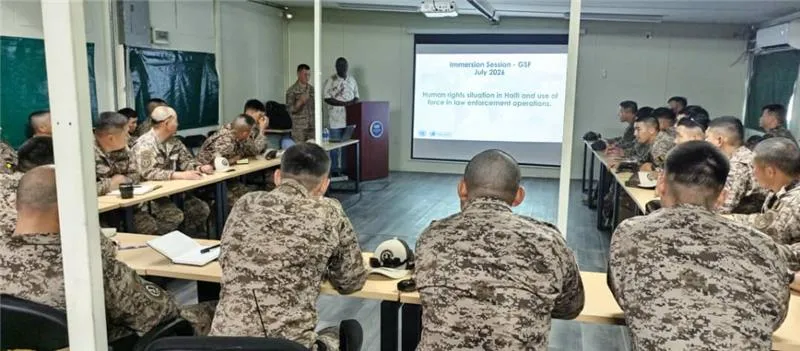
Working together on responsible support
The HNP and the FAd'H have designated senior focal points to support coordination and consistent implementation of the policy. UNSOH also works with the GSF and relevant UN partners including the United Nations Integrated Office in Haiti (BINUH), so that human rights remain part of decisions on the assistance it provides.
The GSF has established a dedicated Protection Team that combines human rights, women's protection, and child protection expertise. The team's role is to integrate human rights considerations into operational planning and implementation. Working with UNSOH, it monitors how mitigation measures are applied as operations evolve.
"For UNSOH, human rights due diligence is a collaborative process with the Haitian authorities, the HNP, the FAd'H, and the GSF," said Susanne Goelles, Chief of the Human Rights Due Diligence Unit at UNSOH. "We analyze risks before support is provided, agree jointly on practical safeguards, and monitor how they are implemented. Our separate engagement with civil society also informs this process."
Prevention, monitoring, and accountability
Human rights due diligence does not end once support has been approved. Monitoring continues for as long as assistance is provided so that measures can be adjusted when circumstances or risks change. These can include training, policy guidance, and technical advice adapted to the operational context, as well as other steps to strengthen compliance with international human rights and humanitarian law.
Where credible information raises concerns about grave violations, the policy provides a framework for engagement with the relevant counterparts, including on corrective action.
Delivering the mandate responsibly
Applying human rights due diligence is part of delivering UNSOH's mandate responsibly. It helps reduce human rights risks, strengthen responsible conduct, and keep UNSOH's support in line with the standards and principles that govern United Nations assistance.


